PO.ET02.03 · 实验与分子治疗
In vitro and in vivo study of C 2 LP-ADC & CLP 2 -ADC targeting human breast and gastric cancer
作者与单位 Authors & Affiliations
摘要 Abstract
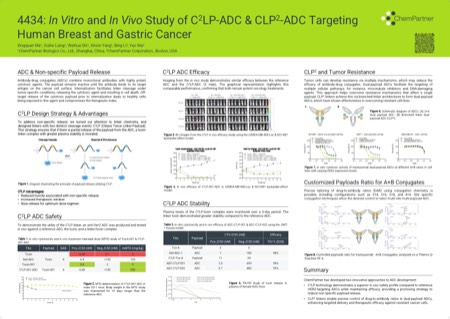
Antibody-Drug Conjugates are a class of targeted cancer therapeutics that combine the specificity of monoclonal antibodies with the potency of cytotoxic agents. This design enables selective delivery of the agents to cancer cells, while avoiding healthy tissue. Some of the challenges that remain with the development of these treatments is the narrowness of the therapeutic window and significant off target toxicity due to non-specific release of the payload. One of the other major challenges is tumor resistance. Leveraging our experience in linker synthesis, we set out to design next-generation linkers that address the persistent challenges of ADC development. Our strategy centered on creating a cleavage cascade system incorporating two distinct cleavage events, enhancing linker robustness and reducing the risk of non-specific payload release (C 2 LP-ADC). As a potential solution to drug resistance, we engineered linkers with the ability to tailor the Drug-to-Antibody Ratio (DAR), enabling incorporation of multiple payloads (CLP 2 -ADC). We synthesized and conjugated analogues of known ADCs for Anti-HER cancers using both C 2 LP and CLP 2 linkers. The C 2 LP was compared in vitro and in vivo to a reference ADC, demonstrating improved therapeutic index and decreased off-target toxicity, with the test subjects maintaining body mass for longer than those treated with the reference-ADC. In addition, the linker-payload complex was demonstrated to be stable in plasma for much longer than the reference-ADC. In vitro treatment of resistant cell lines with CLP 2 -ADC demonstrated enhanced therapeutic efficacy with respect to the reference-ADC.These findings highlight the critical role of linker technology in optimizing ADC performance. Incorporation of C 2 LP and CLP 2 linkers can substantially improve safety, stability, and therapeutic efficacy in ADCs targeting HER-positive breast and gastric cancers, offering a promising strategy for overcoming resistance and minimizing systemic toxicity.
利益披露 Disclosure
X. Ma, None..
G. Liang, None..
W. Shi, None..
B. Li, None..
S. Lu, None..
X. Yang, None..
Q. Chen, None..
G. Wang, None..
Y. Ma, None.