PO.ET06.04 · 实验与分子治疗
Genome-wide CRISPRi screen identifies RPS27 as a novel synthetic lethal target for TP53 mutant cancers
作者与单位 Authors & Affiliations
摘要 Abstract
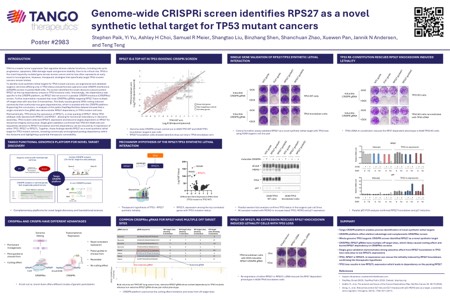
TP53 is a master tumor suppressor that regulates diverse cellular functions, including cell cycle progression, apoptosis, DNA damage repair and genome stability. Due to its critical role, TP53 is the most frequently mutated gene across human cancer and its loss often represent an early event in tumorigenesis. However, therapeutic strategies that specifically target TP53-mutant cancers remain limited. To identify novel synthetic lethal targets for TP53 mutant cancers, we engineered and validated isogenic cell lines differing only in TP53 status and performed a genome wide CRISPR interference (CRISPRi) screen in paired A549 cells. The screen identified the small ribosome subunit protein RPS27 as the top dependency unique to TP53 knockout cells. Interestingly, this dependency was specific to the CRISPRi platform, as RPS27 did not score in a parallel CRISPR knockout (CRISPRko) screen. Further examination revealed that most CRISPRko gRNAs targeting RPS27 have multiple off-target sites with less than 3 mismatches. This likely causes general DNA-cutting-induced cytotoxicity that confounds true gene dependencies, which is avoided with the CRISPRi platform. Supporting this conclusion, re-analysis of the public DepMap/Achilles dataset showed that a single mismatch-free gRNA also demonstrate RPS27 dependency in TP53 mutant cell lines. Mechanistically, TP53 drives the expression of RPS27L, a close paralog of RPS27. While TP53 wildtype cells express both RPS27L and RPS27, allowing for functional redundancy in ribosome assembly, TP53 mutant cells lack RPS27L expression and become largely dependent on RPS27 for ribosomal integrity and survival. Single gene validation confirmed that TP53 KO A549 cells are exquisitely sensitive to RPS27 knockdown and this dependency can be rescued by re-expression of either TP53, RPS27 or RPS27L. Together, these findings identify RPS27 as a novel synthetic lethal target for TP53 mutant cancers, revealing a previously unrecognized paralog-dependency within the ribosome and highlighting a potential therapeutic vulnerability.
利益披露 Disclosure
S. Paik,
Tango Therapeutics Employment.
Y. Yu,
Tango Therapeutics Employment.
A. H. Choi,
Tango Therapeutics Employment.
S. R. Meier,
Tango Therapeutics Employment.
S. Liu,
Tango Therapeutics Employment.
B. Shen,
Tango Therapeutics Employment.
S. Zhao,
Tango Therapeutics Employment.
X. Pan,
Tango Therapeutics Employment.
J. N. Andersen,
Tango Therapeutics Employment.
T. Teng,
Tango Therapeutics Employment.