PO.CL01.05 · 临床研究
The significant co-expression of claudin-3(CLDN3) and B7-H3(CD276) as a potential biomarker for targeted therapy in neuroendocrine carcinomas
作者与单位 Authors & Affiliations
摘要 Abstract
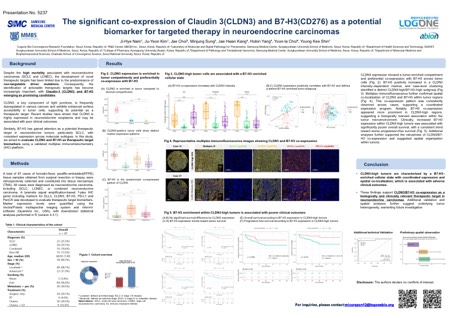
Despite the elevated mortality rate associated with neuroendocrine carcinomas (SCLC and LCNEC; large cell neuroendocrine carcinomas), the development of novel therapeutic targets has been limited by the predominance of non-targetable driver mutations. Consequently, the identification of viable therapeutic targets has become increasingly important, with proteins such as Claudin-3 (CLDN3) and B7-H3 emerging as promising candidates for targeted therapy. CLDN3, a key component of tight junctions in epithelial and endothelial cells, is frequently dysregulated in various cancers. Although CLDN3 is also present in normal tissues, its enhanced surface accessibility in tumor cells highlights its potential as a therapeutic target. Recent studies have demonstrated that CLDN3 is highly expressed in most neuroendocrine neoplasms, and its positivity has been linked to poor prognosis in clear cell renal cell carcinoma. Similarly, B7-H3 has gained attention as a promising target in neuroendocrine tumors, particularly SCLC. The high expression of B7-H3 is consistent across molecular subtypes in SCLC, supporting its relevance for protein-level characterization and the development of novel therapeutic strategies. In this context, the purpose of the present study was to evaluate CLDN3 and B7-H3 as therapeutic target biomarkers using a validated multiplex immunohistochemistry (IHC) platform. A total of 94 cases of formalin-fixed, paraffin-embedded tissues obtained from surgical resection or biopsy were retrospectively collected. All cases were diagnosed as neuroendocrine carcinoma, including SCLC, LCNEC, or combined neuroendocrine carcinoma. A tyramide signal amplification-based 7-plex IHC assay panel has been developed for the evaluation of therapeutic target biomarkers. The expression levels of CLDN3 were elicited by two different methods: single IHC and multiplex IHC assay. These were analysed with a high sensitivity of 93.3% and an area under the curve (AUC) of 0.964 under the receiver operating characteristic (ROC) curve. Among the four targeted biomarkers analyzed using a validated 7-plex IHC method, CLDN3 and B7-H3 were identified as potential therapeutic target biomarkers for neuroendocrine carcinomas. This validated multiplex IHC panel serves as a useful platform for supporting therapeutic development in neuroendocrine carcinomas.
利益披露 Disclosure
J. Nam,
Logone Bio-Convergence Research Foundation Employment.
J. Kim,
Logone Bio-Convergence Research Foundation Employment.
J. Choi, None.
M. Sung,
Samsung Medical Center Employment.
J. Kang, None..
H. Yang, None..
Y. Choi, None..
Y. Shin, None.